ピクセルキーキャップ
Japanese Kawaii · Object Dossier
A keycap whose pixel pattern is finished by its user.
A&N LABORATORY supplies the keycap body and clear lid; the user supplies and places the beads. The checked source explains the 7 × 8 grid and assembly, but not the manufacturing process behind the parts.
Pixel Bead Keycap · SA or DSA profile, 7 × 8 bead grid
Compass Check
Separate what the maker supplies from what the user adds.
01 · Understand
What the kit contains—and what it does not.
The listing name is ピクセルキーキャップ, or Pixel Keycap. The supplied contents are one Cherry MX-compatible keycap body and one clear lid. Delica beads are not included; the user chooses and obtains them separately.
02 · Editorial observation
One point the photograph makes clear.
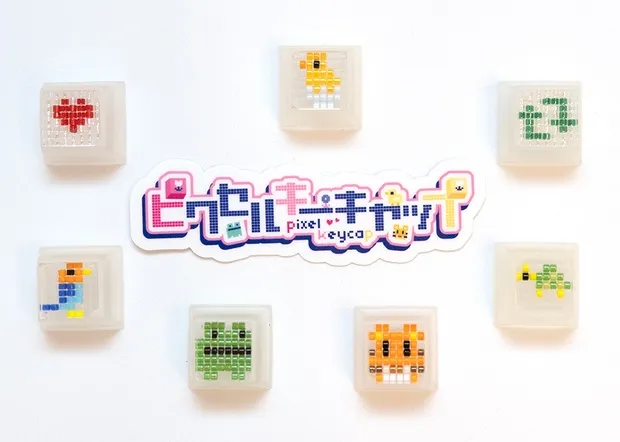
The top surface is not a finished picture. The empty grid remains visible as an invitation to assemble one small pattern, so the object reads as a tool before it reads as decoration.
03 · Evidence
A small grid turns the keycap into a repeatable frame.
A&N LABORATORY presents the object as a way to make a custom keycap more approachable: place standard DB-series Delica beads into the grid, then close the clear lid. The finished pattern sits inside a Cherry MX-compatible keycap rather than on a separate charm or sticker.
04 · Evidence
Resin body, acrylic lid, user-supplied beads.
The maker states resin for the keycap body and acrylic for the clear lid. The grid accepts standard DB-series Delica beads. Assembly uses tweezers to place the beads in the holes before the lid is pressed into place; the listing warns that the lid is basically not removable once closed.
Not verified: the resin-forming method, acrylic-cutting method, factory or workshop process, production time, and the design application’s registration status are not established by the checked source.
05 · Compare
Count the grid and check the profile.
The bead field is 7 × 8. The listing offers a lower DSA profile and a taller SA profile described as roughly R3; both use the same number and size of holes. The user-arranged bead field distinguishes it from a keycap with one fixed printed or sculpted image, while Cherry MX compatibility defines the switch-stem family stated by the maker.
06 · Cross-reference
The source says pixel art; the atlas supplies the editorial route.
The instructions suggest familiar 8 × 8 pixel art as a reference when planning a design, while the physical keycap provides a 7 × 8 grid. That direct use of “pixel art” supports a route to our Retro Game Kawaii Field Note. It does not establish “retro-game kawaii” as the maker’s own name for the object.
07 · Check
The maker role is confirmed; the route conditions still need checking.
The Japanese and English BOOTH pages are language views of the same maker listing. The maker role was reviewed on 2026-07-28. Current terms still belong to the linked pages.
08 · Read next