レトロゲーム可愛い
Japanese Kawaii · Style Field Note
Cuteness made of right angles.
A pixel grid, square keys, and the muted plastics of hardware nobody makes any more. The objects are easy to find. The name is the part we had to supply ourselves.
Kawaii Kinds · Style Field Note · checked 2026-07-27
Compass Check
Read the grid, and mind the name.
This note is unusual for us: the objects are well established and easy to buy, but the label is ours. We say which is which rather than letting one borrow authority from the other.
01 · Understand
First, about the name.
“Retro game kawaii” is our name for this, not an established term. Nobody in Japan is walking into a shop and asking for it. We needed a heading to file these objects under, and this is the one we chose.
The makers do have words for what they make — just different ones. Green Flash describes its pixelook series as Japanese culture expressed in ドット絵 (dot pictures, the Japanese term for pixel art). A&N LABORATORY, who make the beaded keycaps, write about working from 8×8 dot pictures. What is named out there is the technique, not the mood. Our heading is an attempt at the mood, and you should treat it as a shelf label rather than a fact.
We are keeping it anyway, for a reason worth stating: a guide that only files things that already have names will never show you anything you could not have found by searching. Naming a shelf is part of the work. Pretending the name was already there would not be.
02 · Understand
A small world
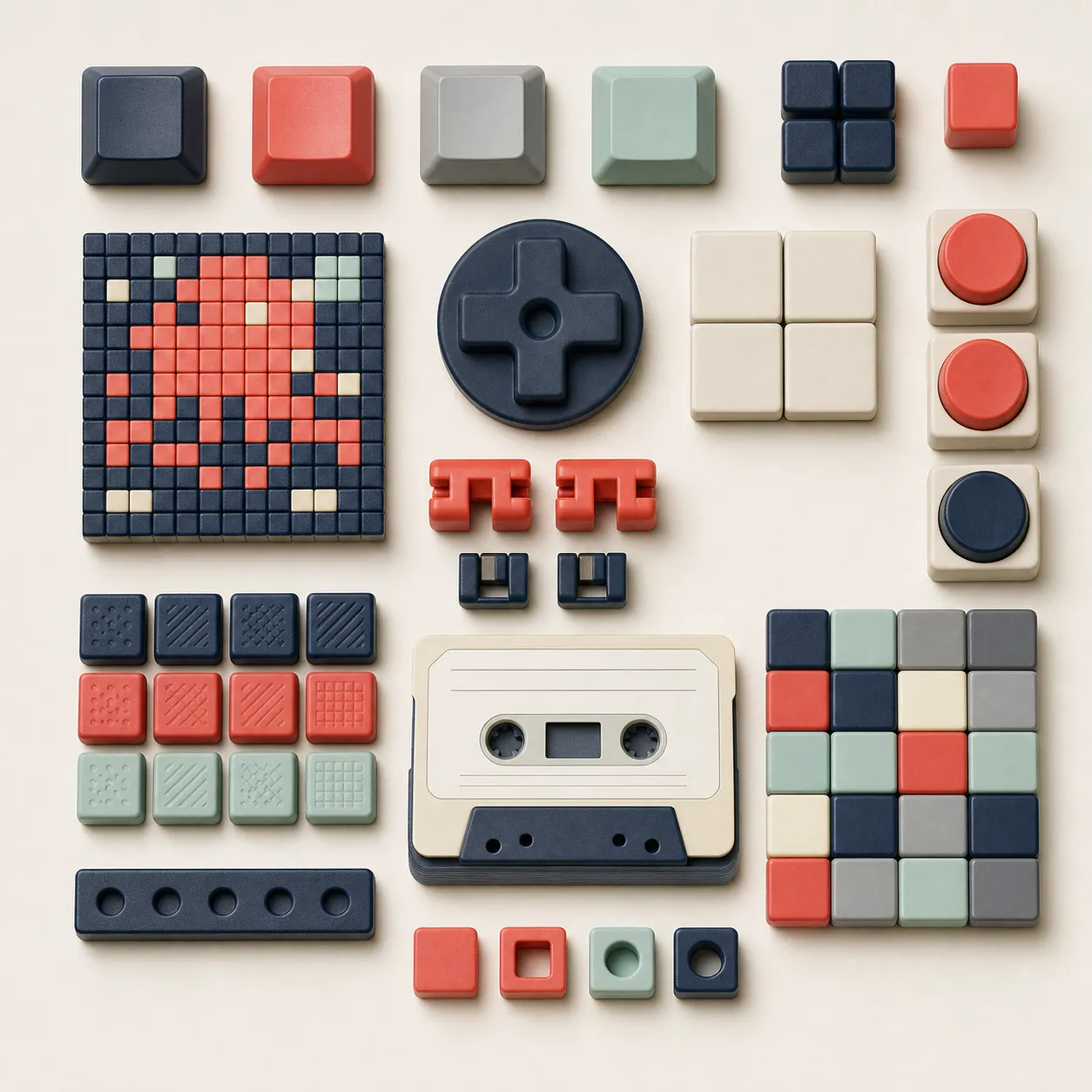
Everything in the specimen above is built from the right angle. Square keycaps, square beads set in a grid, square tiles with textured faces, rubber buttons, a directional pad, a memo pad shaped like a cassette. The palette is not pastel and not bright: navy, coral, sage, grey, cream — the colours of moulded plastic that has sat in a drawer for twenty years.
The cassette is the giveaway. It is not a cassette; it is a memo pad that remembers one. Almost nothing here reproduces a real machine, and the good examples never do — they evoke a console that never shipped, a game that was never released. The nostalgia is for a thing that did not exist, which is why it can be so specific and still belong to everyone.
03 · Look
Look for
These are the cues we use. Like the heading, they are an editorial reading rather than a definition — useful until they stop being useful.
- The grid. A visible pixel or bead grid, or a shape that has been squared off where a curve would be easier. If the resolution is invisible, this is something else.
- Muted plastic colour. Navy, coral, sage, grey, cream. The saturation of injection-moulded parts, not of stationery.
- Small symbols. Hearts, arrows, faces and stars rendered in a handful of squares, where the low resolution is the charm rather than a limitation.
- Invented hardware. Objects that reference consoles and cartridges without reproducing any real one. Anything that copies an actual product is fan merchandise, which is a different question.
04 · Check
Shops to check
A shop page is a place to verify its own current terms, not evidence that a particular item is available or suitable. Both pages below were reachable when checked on 2026-07-27, and both describe their own work in their own words — which is exactly why they are here.
- Green Flash official pixelook series — Official shop
Official shop — check current stock, shipping and returns.
Checked
- A&N LABORATORY official BOOTH shop — Official shop
Official shop — check current stock, shipping and returns.
Checked
05 · Read next
Three notes, and one shelf still unnamed.
Kimo kawaii is the last of the four and remains a cue. It has the opposite problem to this one: the word is real and people use it, but we have not yet found makers who describe their own work with it. The atlas says so plainly rather than filling the gap.
Return to Kawaii Style Atlas