玩具と収集
Toys & Collecting
Start with the small world, not the shelf.
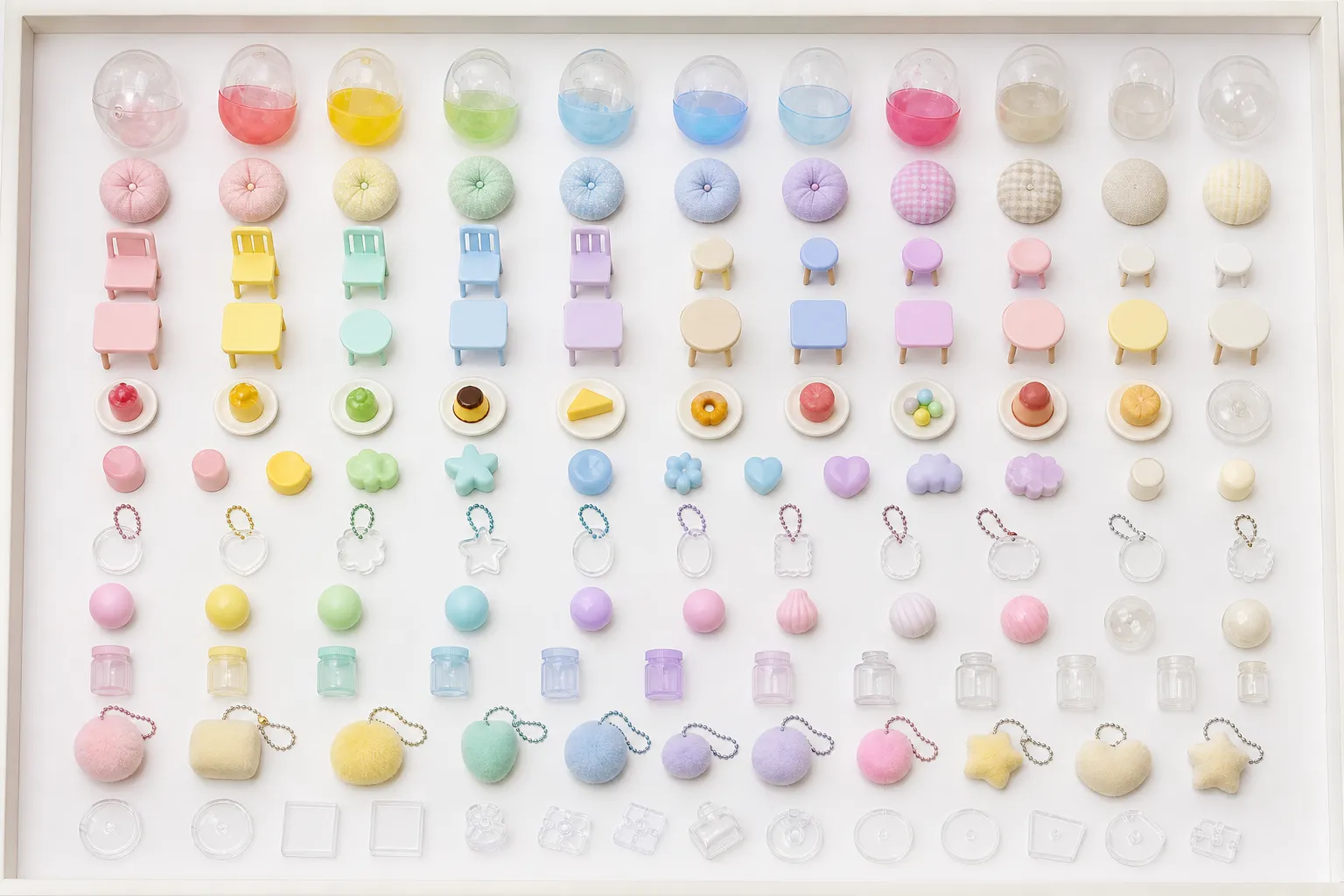
A kawaii toy can be played with, displayed, or collected, and those are three different promises. Read what the object is for before deciding where in your room it goes.
Toys & Collecting / Three roles / One room
01 / Discover · Where to start
What is this object for?
- Decide now
- Whether this is something to play with, something to show, or something to keep.
- Decide next
- If the question starts with a particular person or character, return to the Coverage Map and check whether that reading is in scope.
- Check
- Maker, contents, scale, and any wording that means the item is chosen at random.
A picture is not a promise. Everything here ends at something you can read for yourself.
02 / Understand · Read the object
Read the object before you display it.
A kawaii toy can be for play, display, or collecting, and each asks something different of you. Play asks for durability and somewhere it is allowed to be dropped. Display asks for a surface and a sight line. Collecting asks for room to grow.
The same object can serve any of the three. What changes is what you should check before it arrives.
03 / Compare · Choose its role
Choose its role in your room.
Decide whether this is one object to move, to show, or to keep. An object to move lives where your hands are. An object to show needs a background and a light it looks right in. An object to keep needs somewhere it will not be handled.
Rooms fill up when everything is treated as the third kind. Most things are the first.
04 / Compare · Three readings
Play, display, collect.
The same object changes meaning when its role changes. These three readings are the vocabulary this page hands to everything below it.
- Play
- Handled, moved, and allowed to wear. Ask about materials, joints, and whether small parts come loose.
- Display
- Kept still and looked at. Ask how big it is on a shelf, what it stands on, and how it reads from across a room.
- Collect
- Kept as one of a set. Ask what a complete set is, how it is sold, and whether you get to choose which one arrives.
The third reading is where most surprises live, which is why the next page is about the listing rather than the object.
05 / Check · Read the listing
Check what the listing actually says.
Read the maker, contents, scale, and any random-item wording before treating a picture as a promise. A product photo shows one possible outcome, not the one in the box.
Maker and licence
Who made it, and whether the listing calls it official, fan-made, or says nothing at all. All three exist, and they are not the same thing.
Contents and scale
How many pieces arrive, and how large they are in millimetres. An object photographed against a plain background has no size.
Chosen at random
Blind-box and random-assortment wording means you cannot choose which design you receive. Japanese listings often state this on a separate line from the title.
Availability and price change. This page does not track them — the shop's own page does.
06 / Continue
When the object is not the question.
If your question begins with a particular person, character, or event, pause before treating it as a toy question. The Coverage Map shows what this reading room covers and what remains outside its boundary.