ゆるキャラ
Japanese Kawaii · Term Field Note
Mascots that are supposed to be a bit rubbish.
Round bodies, stubby limbs, dot eyes and a slightly vacant look. Being well designed would spoil it — and unusually for this atlas, we know exactly who coined the word and why.
Kawaii Kinds · Term Field Note · checked 2026-07-27
Compass Check
The looseness is the qualification.
This is the first entry in the atlas that is a term rather than a style — nobody dresses as yuru-chara. It is a word for a kind of character, and it has a documented author.
01 · Understand
Someone made this word on purpose.
ゆるキャラ contracts ゆるい (loose, slack, undemanding) and キャラ (character). The illustrator and essayist Jun Miura coined it, and he has explained why. Speaking to Mynavi News, he said that キャラ implied fame — Mickey and Minnie — and that local mascots filed under that heading looked out of place there. So he built them a category of their own.
“It is a place for those who look like they do not belong anywhere,” he said. The word was made as somewhere for them to stand.
That matters for how you read the rest of this page. Most entries in this atlas describe a look that emerged and got named afterwards, by nobody in particular. This one has an author, a stated intention, and published conditions — the strongest documentation of anything in the atlas.
02 · Understand
The three conditions
Miura set out what qualifies. As reported in the same interview, a yuru-chara should:
- carry a strong message of love for its home region;
- have a bearing that is unstable and unique;
- possess a lovable looseness.
He has also said they should as a rule exist as a costumed suit. Notice what the list does not ask for: professional design, coherent anatomy, or a memorable silhouette. Condition two effectively requires the thing to be a bit off. A mascot that moves smoothly and looks expensive has failed it.
03 · Compare
What you will actually be holding.
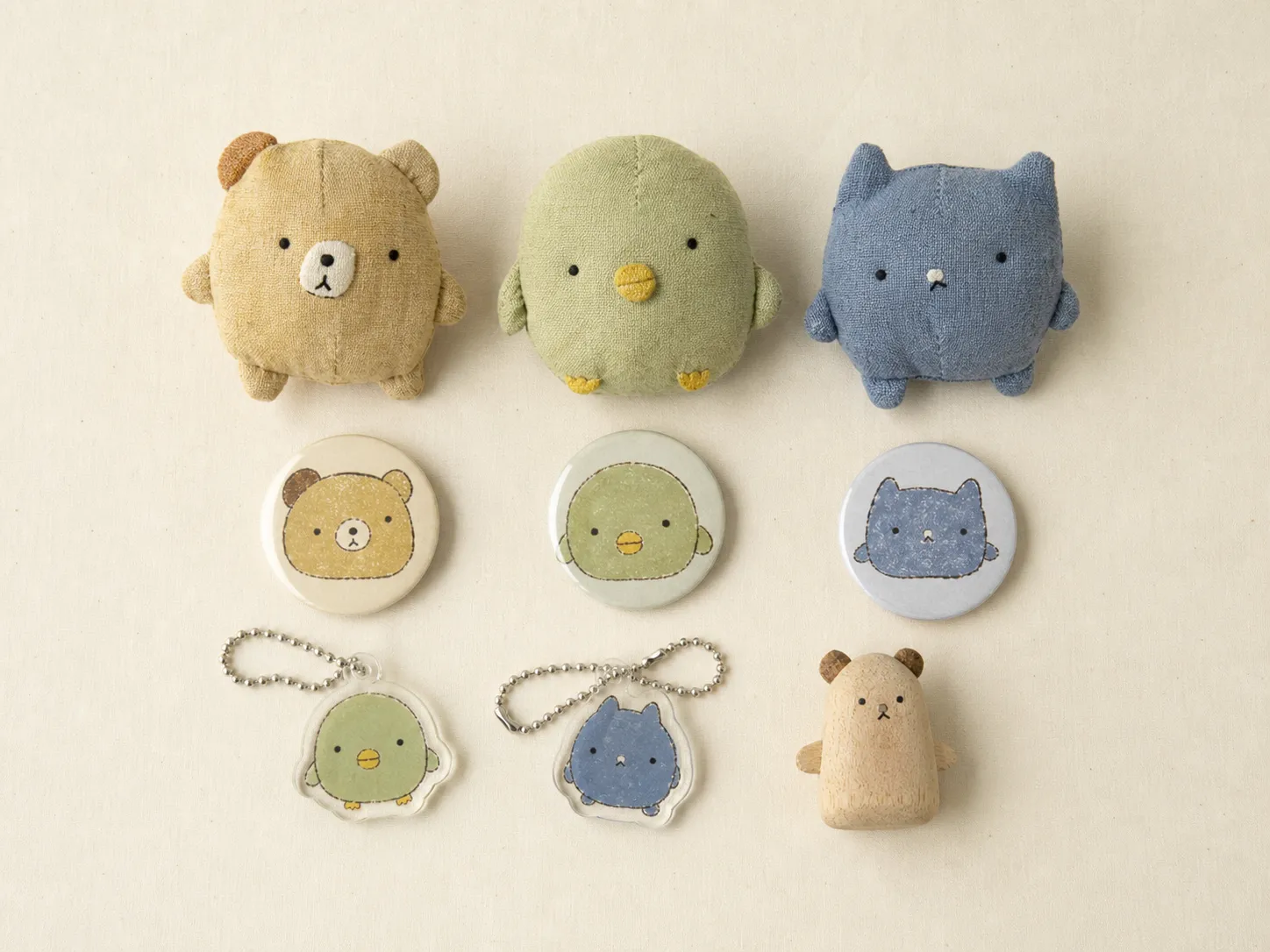
The tray above is goods, not costumes — plush charms, tin badges, acrylic keychains, a small wooden figure. That is a real distinction and we would rather name it than blur it. The mascot proper is a person in a suit at a station or a festival; what crosses a border is the merchandise made from it.
Read the goods and the conditions still show. The bodies are round to the point of being spherical, the limbs too short to reach anything, the eyes plain dots. Colours are muted — ochre, sage, slate — rather than the saturated primaries of a licensed character. Faces are close to symmetrical but not quite. Everything is a little worse than it could be, and that is the specification, not a defect.
04 · Compare
Near, but different
The nearest neighbour in this atlas is kimo kawaii, which also trades on things being wrong. The difference is where the wrongness sits. Kimo kawaii puts it in the face — eyes that do not match, a mouth that gave up. Yuru-chara puts it in bearing and competence: the face is usually fine, but the thing cannot quite carry itself.
It also differs from every style note here in a basic way. Yami kawaii, yume kawaii, jirai-kei and ryōsangata are things people wear. Nobody dresses as yuru-chara. It is a category of character, which is why it sits under terms rather than styles.
05 · Check
Why there is no shop list here.
Two notes in this atlas end without shops, for opposite reasons. With kimo kawaii we looked and could not find sources we would stand behind. Here we could find them easily, and chose not to.
Yuru-chara goods are merchandise for specific mascots, each owned by a particular town, prefecture or organisation. Listing shops would mean promoting individual characters, and picking which ones. That is a different job from explaining how to read the category, and not one we are set up to do fairly.
What we can point you to is the source for everything above — the interview in which the man who made the word explains what he made it for.
- Mynavi News interview with Jun Miura, who coined the term — Reference source
Japanese-language interview. The source for the coinage, the quoted line, and the three conditions.
Checked
06 · Read next
The first term, and the best documented thing here.
This is where the atlas starts covering words as well as looks. It is also, by some distance, the entry we can support best: a named author, his stated reason, and published conditions. Set that beside yume kawaii, whose origin we could only report as hearsay, or retro game kawaii, whose heading we had to supply ourselves. Six entries, six different strengths of record, and we would rather show you that unevenness than flatten it.
Return to Kawaii Style Atlas