きもかわ
Japanese Kawaii · Style Field Note
The face is wrong and you want it anyway.
Eyes that do not match, a mouth that gave up, limbs of different lengths — and none of it reads as horror. Something in the making keeps it warm.
Kawaii Kinds · Style Field Note · checked 2026-07-27
Compass Check
Notice that you are not repelled.
This note ends without a shop list. We looked and did not find sources we could stand behind, so we say that instead of filling the space.
01 · Understand
What is Kimo Kawaii?
Kimo kawaii, or キモかわいい, contracts気持ち悪い (unpleasant, off-putting) andかわいい. Kawaii researchers Namiha Ihara and Hiroshi Nittono record it as a compound adjective that joins opposing elements. A TV Tokyo programme record applies the question to people, a figure, and pets, so the checked use is not limited to mascots.
The mistake worth avoiding is reading it as “ugly but cute”. Ugliness is not the mechanism. What produces the effect is a face that fails at being a face while everything around it stays gentle: eyes at different heights, a mouth stitched shut and then reopened, a body sewn by hand and slightly off. You register the wrongness first and the warmth immediately after, and the gap between those two moments is where the appeal lives.
02 · Understand
A small world
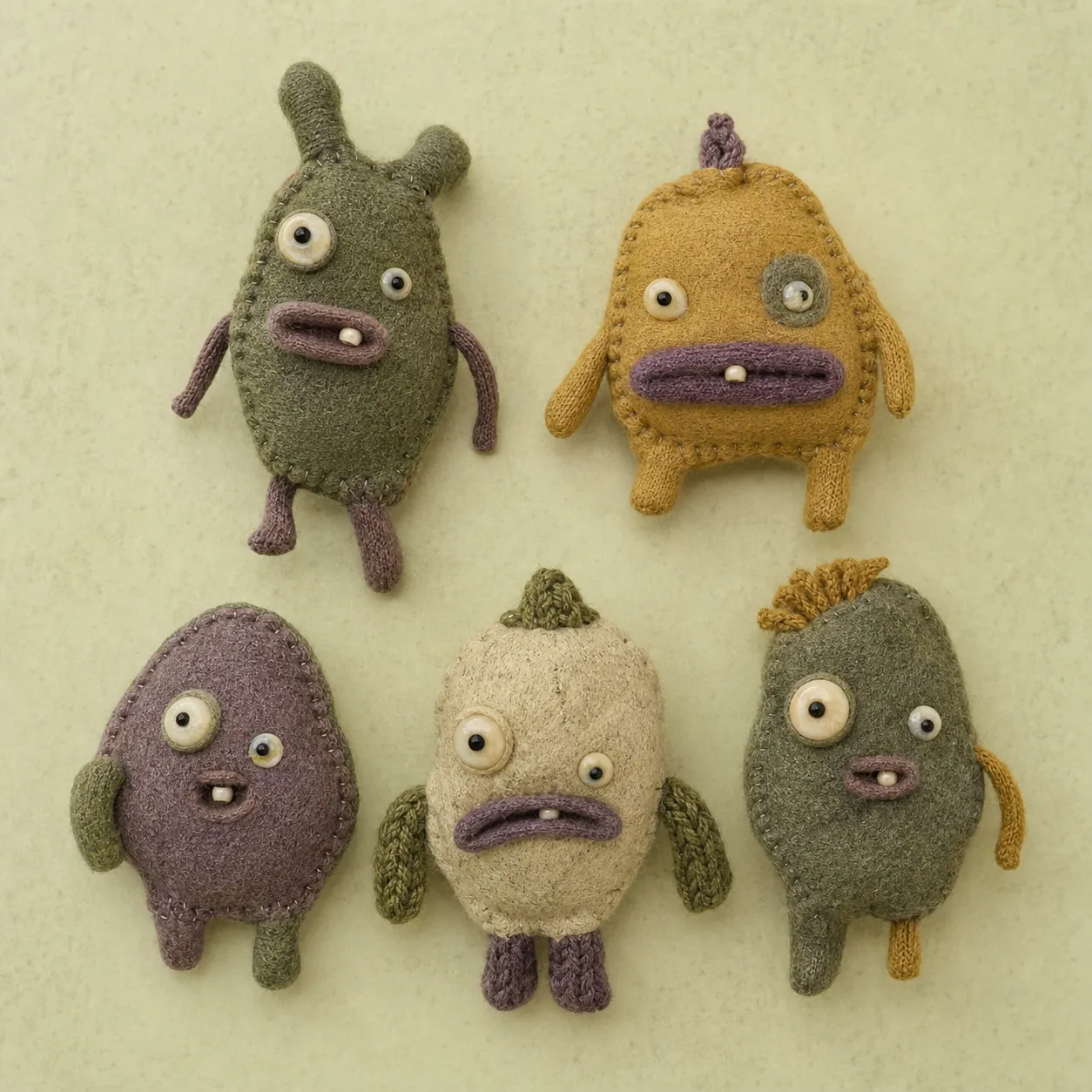
Look at the five creatures above and try to find two matching eyes. There are none. Each face has one large eye and one small one, set at different heights, and the mouths are embroidered as if the maker changed their mind halfway through. One has a single bead for a tooth. Limbs are attached at angles no anatomy would produce.
Now notice what stops it becoming unpleasant. Every seam is a blanket stitch, done by hand and left visible. The palette is moss, plum, mustard and cream — the colours of wool, not of decay. Nothing is sharp, nothing is wet, nothing is imitating a real animal. Kimo kawaii lives in a narrow band, and the material is what keeps it inside.
03 · Look
Look for
Editorial reading. These are the cues we use rather than a definition supplied by either checked source. Keep them only while they remain useful for describing what is visible.
- Mismatched eyes. Different sizes, different heights, sometimes different materials. The single most reliable signal.
- A face that fails on purpose. The expression does not resolve into happy or sad. It is stuck between, and it stays there.
- Visible making. Hand stitches, uneven limbs, lopsided repeats. Evidence that a person made this and let the errors stand.
- Warm material. Wool, felt, soft vinyl. If the surface turns hard, wet or realistic, the register tips into something else and the affection goes.
04 · Sources
Source Ledger
These records support the compound expression and its observed range. They do not authorise the face-and-material checklist above, which remains an editorial reading.
05 · Check
Why this note has no shop list.
The other three notes end with shops you can check for yourself. This one does not, and the reason is worth more to you than a list we were not sure about.
Searching for kimo kawaii goods returns marketplace result pages almost exclusively. We do not link to marketplaces or affiliate destinations — not as a matter of taste, but because a search result is not a source, and a page assembled from many sellers cannot tell you who made anything.
The most promising lead turned out to be a warning in itself. A gallery show called キモかわいい展 genuinely exists, which is good evidence that the word carries real weight. But the domain that used to host it now serves a completely unrelated commercial site —and it still returns a perfectly healthy 200 OK. Had we checked only that the link worked, we would have sent you somewhere with nothing to do with any of this. It is a useful thing to know when you follow links out of any older article about Japanese subcultures, this one included.
So the shop list stays empty until we find makers we can name. That is a report on where we got to, not a claim that none exist.
06 · Read next
Every note has its own kind of gap.
Every entry in the atlas can now be read, and no two are documented the same way: yami kawaii has its creator on record, yume kawaii has shops using the word but no settled origin, retro game kawaii has the objects but the name is ours, and this note has the word and the makers but no source we can hand you. Yuru-chara also ends without shops — but for the opposite reason, which its own page explains. A guide that flattened those situations into one voice would be easier to read and worth less.
Return to Kawaii Style Atlas