量産型
Japanese Kawaii · Style Field Note
Looking like everyone else, on purpose.
Pale pink, beige, white and blue; frills, ribbons, and the same clip four times over. This is the one Japanese style where matching the crowd is the point — and the name for it was never meant kindly.
Kawaii Kinds · Style Field Note · checked 2026-07-27
Compass Check
Read the repetition, not just the colour.
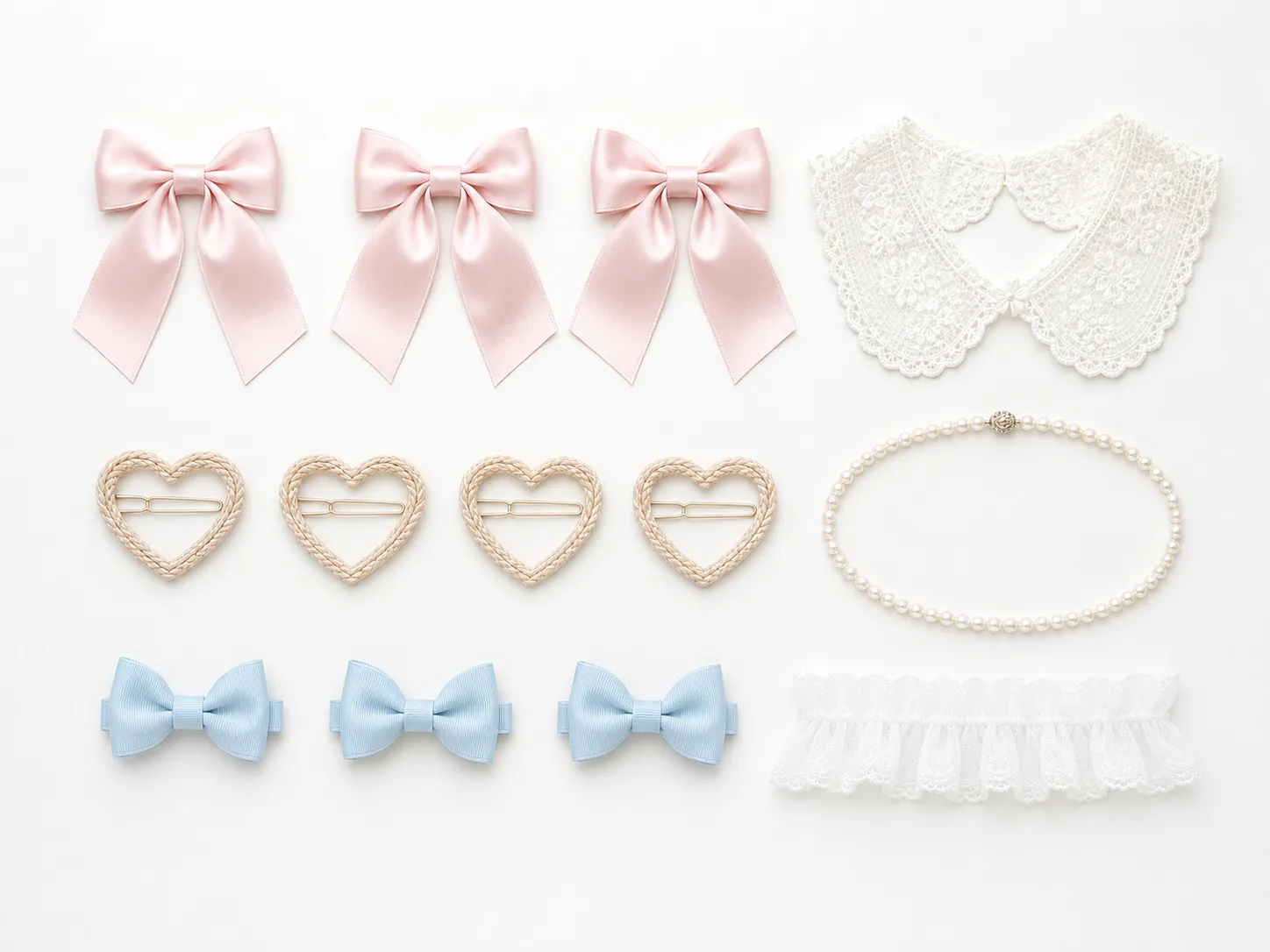
The tray looks sweet, and the sweetness is not the finding. Count the clips: there are four of the same one. Sameness is the style.
01 · Understand
The name is not a compliment.
量産型 means “mass-produced type”. It appeared in the early 2010s, our reference says, for women who wore the trend exactly as it came and so ended up looking alike — and the phrase it uses is “a loss of individuality in the service of wanting to be seen as cute”. It later settled on a specific look among fans of certain male idol groups.
So this is the second note in a row where the name came from a judgement about people, not from a description of clothes. Jirai-kei has the same problem from a different angle. We handle it the same way: say where the word came from, then talk about garments. This guide does not classify people, and it is not for us to tell anyone whether their outfit lacks individuality.
What is worth saying is that the sameness is chosen. Turning up in what everyone else is wearing, on purpose, is a different act from failing to be original — and most writing in English misses that entirely.
02 · Understand
A small world
Look at the tray and count. Three identical pink bows. Four identical beige heart clips. Three identical blue ribbon clips. Nothing here is rare, and nothing is trying to be. The repetition is not a shortage of ideas; it is the idea.
The palette is pale pink, beige, white and pale blue — light throughout, with no dark anchor anywhere. Add a black bow and the tray tips into a different style entirely. The light is flat and even, the shadows almost gone, and everything is lined up in rows. Neatness is doing as much work here as colour.
03 · Look
Look for
These are the cues we use — an editorial reading rather than a definition, useful until they stop being useful.
- Repetition of the same piece. The single most reliable signal, and the one most often missed. If you can see four of the same clip, you are looking at this.
- Light colour with no dark anchor. Pink, beige, white, pale blue. Our reference names exactly this range.
- Frills and ribbons, worn plainly. The decoration is conventional on purpose. Nothing is subverted.
- Neatness as an effect. Even hems, tidy hair, matched sets. Deliberate tidiness reads as part of the look.
04 · Check
Shops to check
The shop below uses the word for itself, which is our test — plenty of brands get called ryōsangata by third parties while describing themselves quite differently, and we do not put words in their mouths. A shop page is a place to verify its own current terms, not evidence that a particular item is available or suitable. Checked 2026-07-27.
- NOEMIE official store — Official shop
Official shop — check current stock, shipping and returns.
Checked
- Japanese Wikipedia entry on ryōsangata and jirai-kei — Reference source
Japanese-language encyclopedia entry. The source for the origin of the term, the colour range, and the relationship with jirai-kei.
Checked
05 · Read next
Two names, both handed down rather than chosen.
Neither this style nor jirai-kei was named by the people who wear it. Both labels arrived from outside, as remarks about the sort of person who dresses that way, and stuck to the clothes afterwards. That is worth knowing before you use either word — and it is a different situation from yami kawaii, where a named creator put the term forward herself.
Return to Kawaii Style Atlas