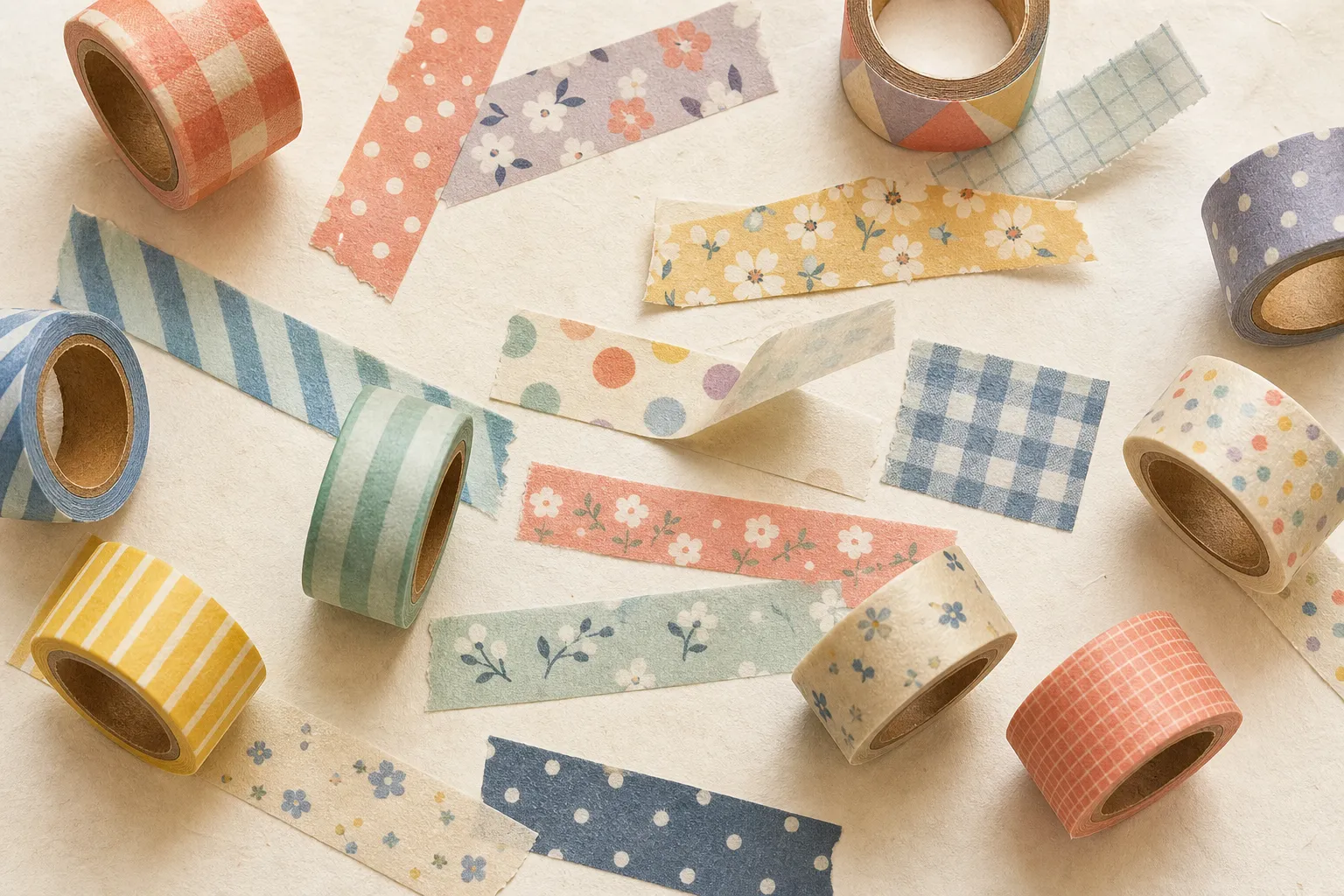
マスキングテープ
Japanese Objects · Know the Kind
Masking tape has more than one working life.
Kamoi’s own timeline places paper adhesive tape decades before its stationery-and-zakka line, mt. That sequence gives Japanese decorative tape an industrial lineage without turning every colourful roll into the same product.
Kawaii Kinds · Object Kind · checked 2026-07-28
Evidence state
Read the use label before the pattern.
Source-linked. Claims below stay within the stated source role. Product details apply to the named example.
01 · Understand
From sealing work to the stationery shelf.
Kamoi records the start of its paper adhesive-tape production in 1961, a washi adhesive masking tape for sealing work in 1981, and the launch of the stationery-and-zakka brand mt in 2008. This is one manufacturer’s documented path, not a claim that Kamoi invented every form of masking tape or washi tape.
02 · Read the kind
Read the use label before the pattern.
Kamoi’s current product guide separates stationery-and-zakka mt from interior products and industrial masking categories. For this guide, “washi tape” is safest when a maker identifies the roll’s material or stationery use. A printed surface by itself does not prove the backing, adhesive behaviour, or intended surface.
Check these fields
- Maker-stated use: stationery, packaging, painting, construction, or interior work
- Maker-stated backing or material
- Width and length for the task at hand
- Surface and removal instructions, when the maker provides them
03 · Boundary
Decorative is not a material specification.
Not verified. Do not promise that every decorative roll is made from Japanese paper, can be repositioned, or will lift without residue. Those properties vary by product and surface. If the maker does not state them, show “Not verified.”
04 · Source note
One manufacturer’s documented path.
The history on this page comes from Kamoi, a manufacturer describing its own products. It is primary and commercially interested. Use it for Kamoi’s dates, product names, and categories—not as a neutral history of the entire global tape market.
Sources and limits
Read each source by its role.
Kind-level sources support only the stated history, function, or technical boundary. An example source supports that individual image and record, not the whole kind.
03 · Read next