デフォルメ/SD
Japanese Kawaii · Term Field Note
Deformation changes the balance, not only the size.
A smaller copy keeps the same proportions. A deformed character does not. The sculptor Shinya Iguchi describes the work as repeated balance adjustment: simply shrinking something realistic will not produce the Nendoroid form he makes.
Kawaii Kinds · Term Field Note · checked 2026-07-28
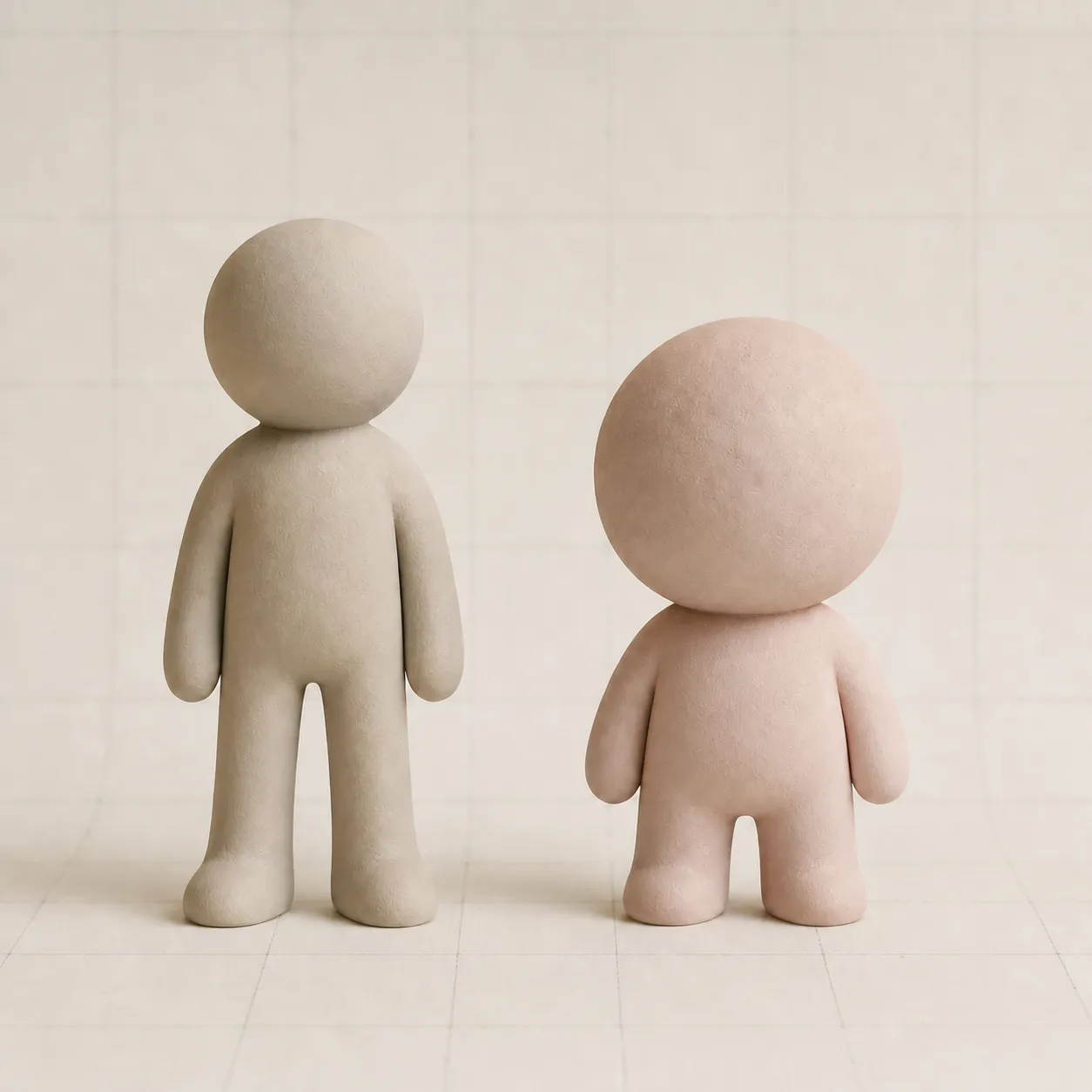
Compass Check
Read the proportion change, then check the maker’s word.
Use only to show that proportions can be rearranged. Do not use it to prove Nendoroid’s 2.5-head example, any universal SD ratio, or the appearance of a commercial product.
01 · Term Field Note
What is deformation?
Evidence · scope limited
In this guide, deformation means a deliberate rearrangement of proportion used to carry a character into another visual form. The strongest checked explanation comes from practice. Iguchi, a lead Nendoroid sculptor, says that a realistic figure cannot simply be made smaller; different balances have to be adjusted until it becomes that series’ deformation. The maker’s own series page gives one concrete result: Nendoroid describes its figures as about ten centimetres high and 2.5 heads tall. Keep the scope visible. “2.5 heads” is Nendoroid’s self-description, not a rule for every deformed character in Japan.
02 · Term Field Note
A small world
Editorial reading
Proportion changes what gets room. A larger head can preserve hair, face, and a recognisable expression while the torso and limbs become shorter. The maker still has to protect pose, costume, and identity; the sculptor describes this as a balance problem rather than a scale operation. That is why two figures at the same height can feel entirely different: one may be a small realistic figure, while the other has been redesigned around a new head-to-body relationship.
03 · Term Field Note
Read what changed and what survived.
Evidence · scope limited
First, compare head size with torso and limb length. Second, look for features preserved to keep the character identifiable: hair mass, face, costume, or a signature object. Third, check whether pose and articulation were redesigned for the altered body. Finally, read the maker’s own series name. A cute small figure is not automatically Nendoroid, SD, or any other protected product line.
04 · Term Field Note
SD is a recorded label, not one universal measurement.
Evidence · scope limited
Bandai’s archive pairs an SD Gundam character label with the 1986 product name “Gundam Super Deformed.” That is solid first-party evidence for the words inside that product history. It does not establish one head-count, one construction standard, or ownership of every deformed character. Use SD when the work or maker uses it; otherwise describe the altered proportion you can verify.
05 · Term Field Note
Official checks
Evidence · scope limited
Good Smile Company is the first-party check for Nendoroid’s 2.5-head description and its sculptor’s process. Bandai’s archive is the first-party check for the recorded SD Gundam product name. Both are commercial sources explaining their own lines, not neutral dictionaries for all character art.
06 · Term Field Note
Read next
Return to the term atlas for other documented visual words. Do not link “chibi,” “mini,” or “super deformed” as synonyms until a relationship record establishes the scope of each word.
07 · Sources and limits
Source Ledger
The sources define their own series, product history, or production practice. None is a neutral dictionary for every deformed character.
08 · Read next