デコラ
Japanese Kawaii · Field Note
Decora: more is arranged, not random.
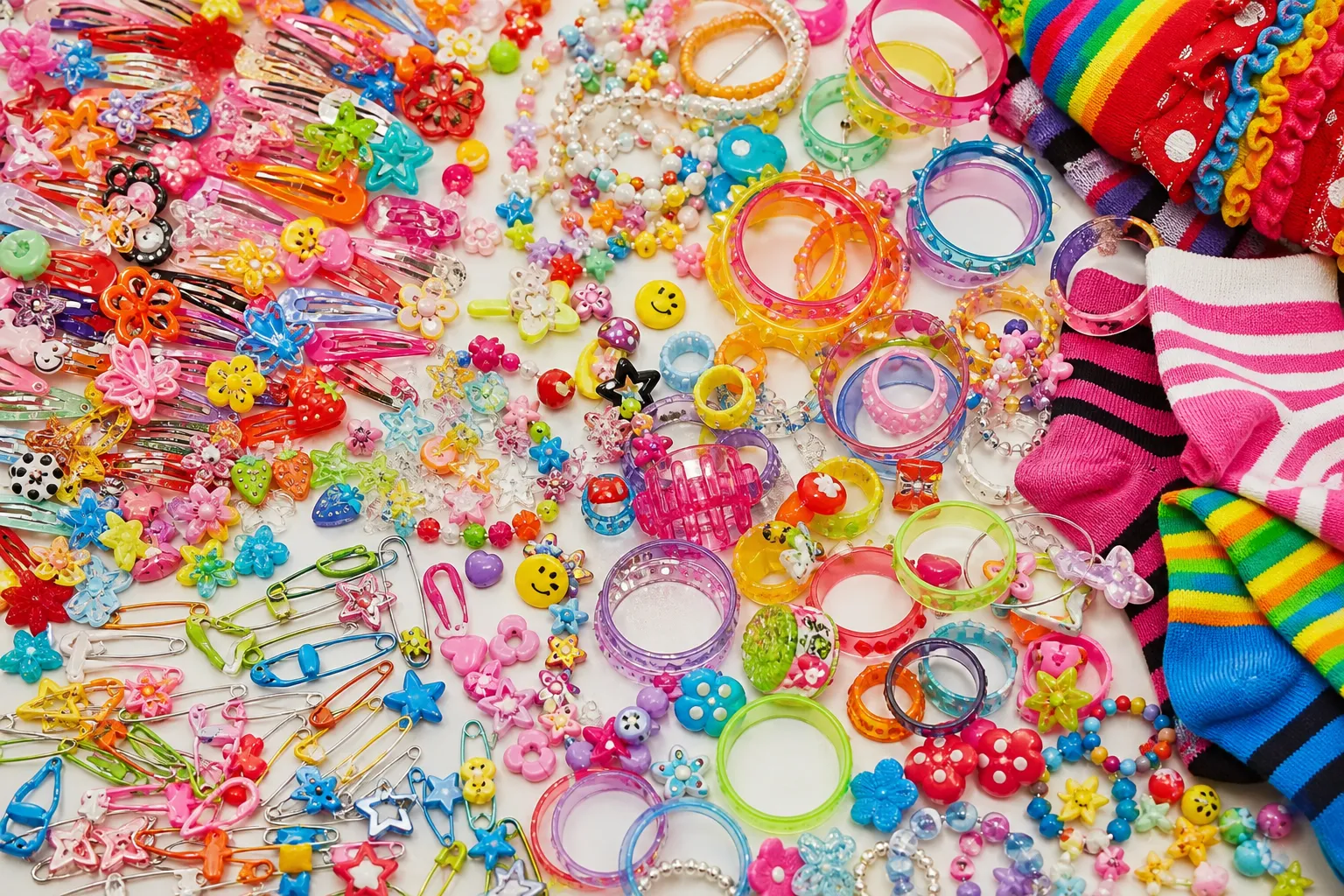
Hair clips can cover the fringe, stickers can become make-up, and a small everyday object can be rebuilt as an accessory. The density is obvious. The editing inside it is the point.
Kawaii Kinds · Style Field Note · checked 2026-07-28
Compass Check
Read the arrangement before counting the parts.
This Field Note follows checked Japanese records and keeps editorial readings labelled. What the sources do not establish remains visible as Not verified.
01 · Understand
What is Decora?
Editorial reading. Decora is best approached here as a Japanese street-fashion practice built through visible layers of decoration. That is a working description, not a claim that one shop or one person owns the complete definition. In a first-person interview, the active dresser NICO explains that she keeps unity in her main colours and adjusts the total volume even when many accessories are present. In another interview, street-fashion editor Shoichi Aoki remembers a peak when Decora could look costume-like in a single photograph, while the people developing it understood it as street fashion with its own continuity.
Secondary observation. A FASHIONSNAP feature connects the scene to decorative club styling and punk bricolage before discussing its Japanese development. That route is useful historical interpretation, but it is secondary. This guide does not assign Decora one inventor or an exact first year.
02 · Understand
A small world
NICO’s account makes the scale of the world unusually clear. Blue and pink hold her look together. Accessories are collected, made, and rebuilt by adding parts to inexpensive bases. Stickers and adhesive bandages move from the stationery drawer or first-aid kit onto the face as decoration. Hair clips begin as a few pieces, then cross, repeat, and spread across the fringe. None of these objects works alone. Their repetition and placement turn many small decisions into one visible surface.
03 · Look
Read the arrangement before counting the parts.
These cues come from one participant’s described practice. They help us read her example; they are not a universal checklist.
Not verified. These cues should not be used to police who is or is not Decora. No checked record establishes one mandatory visual checklist.
- A field of hair accessories.Look for repeated hair accessories placed as a field rather than a single accent.
- Practical objects used as surface.Notice when stickers or bandages are treated as colour and surface, not only as practical objects.
- Visible handwork.A familiar base may be changed by added charms, parts, or combinations.
- Balance inside abundance.Read the balance of colour and volume. NICO explicitly describes unity and adjustment, so abundance should not be reduced to “anything piled together.”
04 · Check
One Harajuku brand context, not a universal authority.
6%DOKIDOKI’s official history says the shop opened in Harajuku in 1995 and names its own concept “Sensational Kawaii.” That makes the page a useful first-party check on the brand’s place and self-description. It does not make the shop the inventor or official definition of Decora, and the current page does not verify that every item is available.
05 · Sources and limits
Sources have different kinds of authority.
NICO’s interview is primary for her own practice. Aoki’s interview is primary for his recollection as a street-fashion editor. The dedicated FASHIONSNAP history is secondary interpretation. 6%DOKIDOKI’s About page is primary only for that brand’s own history and concept. No checked record establishes one inventor, a single origin date, or one mandatory Decora checklist.
06 · Read next
Return to the Style Atlas.
Return to the Style Atlas to compare other Japanese kawaii field notes. Follow a nearby-term link only when the relationship ledger has a checked record; visual resemblance alone is not enough.